Duplicated interpretation
The same underlying obligation is interpreted repeatedly across FDA, EU GMP, ICH, PIC/S and internal standards.
Compliance intelligence for pharmaceutical organizations
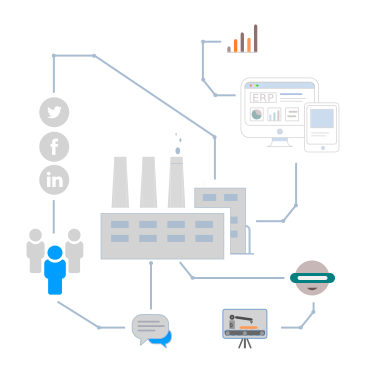
Aurexios sits above QMS, document, training, validation, risk and audit systems. It turns fragmented regulatory and operational data into a connected compliance state that can be measured, explained and simulated.
Mature pharma platforms execute workflows well. What they rarely provide is a unified intelligence model connecting regulatory obligations, controls, evidence, findings, risk, decisions and change impact across systems.
The same underlying obligation is interpreted repeatedly across FDA, EU GMP, ICH, PIC/S and internal standards.
Controls, evidence, findings, risks and decisions live in different tools, making the compliance picture difficult to defend.
Regulatory change still requires manual reasoning to determine which controls, procedures and evidence are actually affected.
Activity metrics do not provide a consolidated view of coverage, residual risk, open obligations and data quality.
Aurexios builds and projects a control-centric regulatory model while your operational platforms remain the systems of record.
Ingest versioned regulations, normalize clauses, preserve applicability and maintain source traceability for downstream reasoning.
Regulations → clausesGenerate regulation-agnostic candidates, normalize a stable key and preserve source-specific lineage through ControlVersions and clause mappings.
Many sources → stable identityProject requirement-to-control coverage, calculate explainable percentages and surface uncovered requirements and orphan controls.
Coverage → gapsUse clause diffs and control mappings to identify impacted controls and SOP versions and propagate reassessment needs.
Change → impactAnalyze SOP compliance, create traceable findings and connect evidence without replacing the source document system.
Assessment → proofTurn signals from findings, CAPAs, risks and coverage into AI-assisted insights, recommendations and briefings with explicit provenance.
Signals → recommendationsFreeze a compliance baseline, apply hypothetical mutations and deterministically simulate propagated impact before operational records change.
What-if → simulationRecord decision attestations, reviewer accountability, MFA evidence and external approval references with tamper-evident audit chains.
Decision → evidenceGenerate deterministic KPI dashboards and exchange normalized events through secure inbound APIs and HMAC-signed webhooks.
State → visibilityAurexios is designed to determine when requirements from different regulatory sources express the same underlying obligation—without losing the source-specific wording, applicability or provenance behind that conclusion.
Reuse an existing canonical control immediately when the normalized identity already exists.
Classify the candidate by control domain, objective and obligation type to constrain the comparison space.
Retrieve the most plausible existing canonical controls within the relevant taxonomy neighborhood.
Measure conceptual similarity between the new obligation and retrieved canonical-control candidates.
Compare subject, required action, object, conditions, applicability and expected evidence—not just wording.
Determine whether the requirement is equivalent to an existing canonical obligation or represents a genuinely new control.
Attach the new source-specific interpretation to the stable control identity.
Establish a new stable identity when the obligation is materially distinct.
See covered and uncovered regulatory requirements through explainable, event-driven projections.
Trace clause changes through mapped controls to impacted SOP versions and reassessment requests.
Test hypothetical mutations against a frozen baseline with the Compliance Digital Twin.
Use deterministic KPIs, trends, data-quality indicators and a versioned compliance posture score.
Aurexios intentionally avoids replacing mature operational workflows such as SOP approval, training, deviation execution, CAPA approvals or electronic signatures.
Its integration layer normalizes inbound data, applies tenant-aware idempotency and request tracking, and publishes intelligence through traceable HMAC-signed webhooks.
Regulatory graph · canonical controls · coverage · change impact · AI intelligence · Digital Twin · governance · reporting
Keep your operational systems of record. Add the intelligence and reasoning layer they were never designed to provide.